
 English
 русский
 Español
 عربى
عربى
Mini Glass Spray Bottles Manufacturers
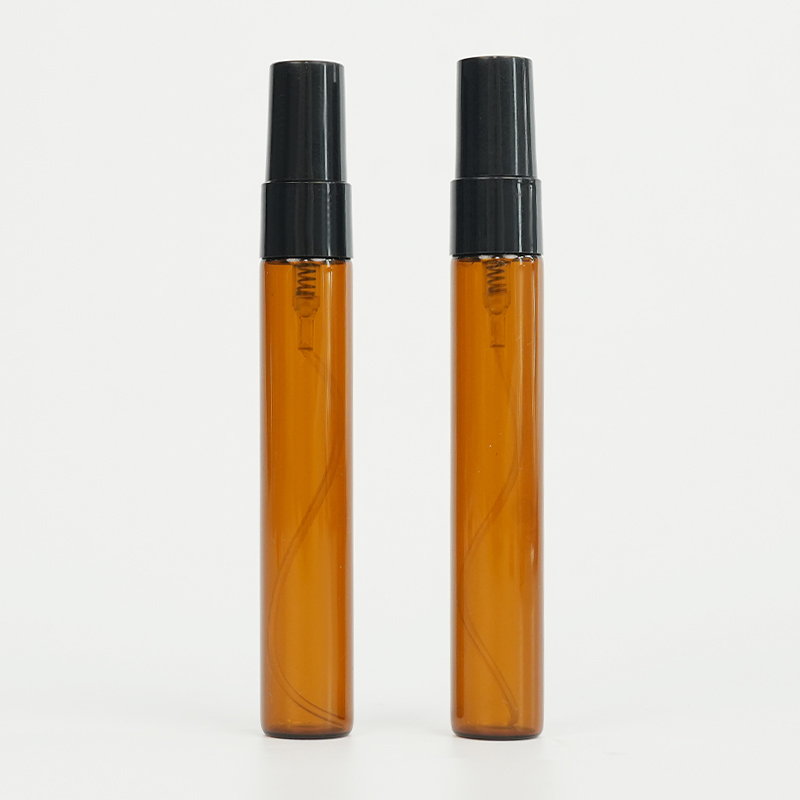
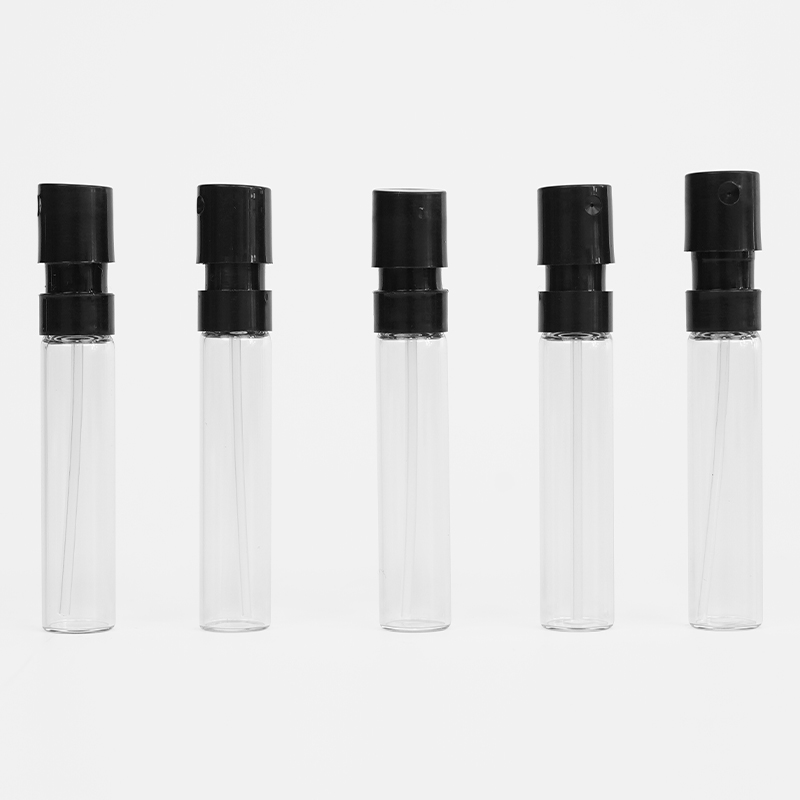
Glass spray bottles are primarily used for the dispensing, airtight storage, and daily spraying of liquids such as hydrosols, essential oil solutions, skincare toners, disinfectant sprays, aromatic mists, and medical-grade repair serums. They serve as versatile glass packaging containers across the beauty, aromatherapy, personal care, and disinfection industries.
Primary Uses:Suitable for filling, sealing, spraying, and transporting products such as toners, botanical hydrosols, essential oil blends, perfumes, portable disinfectant sprays, pet care solutions, herbal extract sprays, and travel-sized liquids.
Material Characteristics:Made from soda-lime-silica glass and available in clear or light-blocking amber styles. The material offers excellent chemical stability, is resistant to reactions with aqueous solutions or essential oil ingredients, and does not leach harmful substances, meeting safety standards for daily chemical packaging.
Structural Design:Features a standard threaded neck compatible with various plastic fine-mist pumps, aluminum spray heads, and external dust caps. The bottle neck is precision-engineered for a tight, secure fit with the pump mechanism. The bottle body is formed as a single piece with uniform wall thickness, ensuring an excellent seal after assembly.
Key Advantages:The clear glass offers excellent product visibility; amber bottles block UV rays, slowing the oxidation of light-sensitive liquids. Compatible fine-mist sprayers provide uniform atomization and smooth operation while preventing leakage. A wide range of specifications is available, allowing for flexible pump combinations and customization options such as screen printing, frosting, and hot stamping.
Precautions: It is recommended to clean and dry the bottle before filling. Amber glass bottles are preferred for ingredients prone to oxidation or light sensitivity. Avoid prolonged storage at high temperatures, and ensure adequate cushioning and protection during transport to prevent breakage from impact.
About Ousibei
As China Little Glass Spray Bottles Manufacturers and Small Spray Bottles Glass Suppliers, Ousibei specializes in the research, development, and production of glass
packaging materials, supported by a complete production system and quality control process.
 Read More




News
-
As a glass packaging manufacturer with over two decades in the field, we've seen how the right vial can make all the difference in product stability and user confidence. Among the many formats we produce, the tubular glass vial stands out as a versatile and reliable choice for e...
READ MORE -
Oral liquid products place special demands on packaging. The bottle must protect the formulation, maintain stability over time, fit high-speed filling lines, and communicate trust to the end user. As a glass packaging manufacturer with more than two decades of experience, we hav...
READ MORE -
Materials & Packaging Glass or Plastic: The Real Lifespan of a Liquid Medicine Bottle Two materials, two very different definitions of "durable." One resists chemical aging for decades. The other survives the drops, shipping, and daily handling that actually destroy bottles....
READ MORE
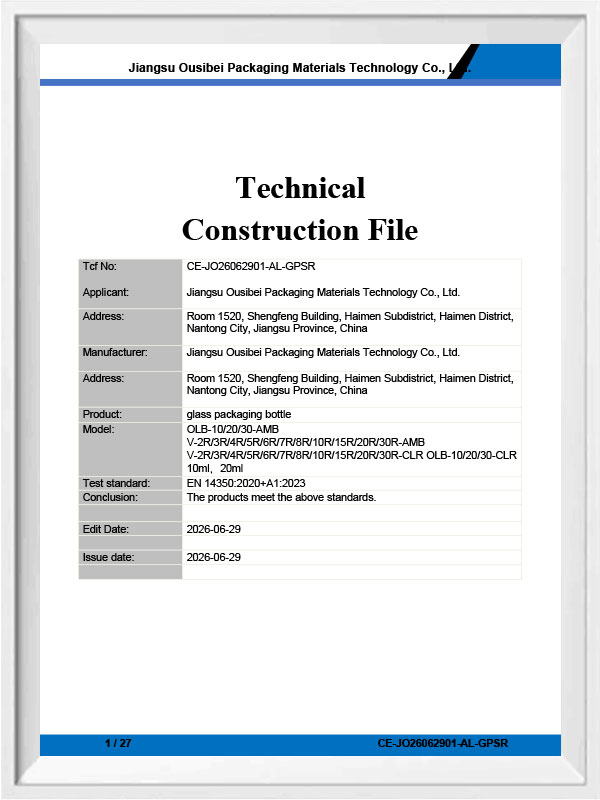
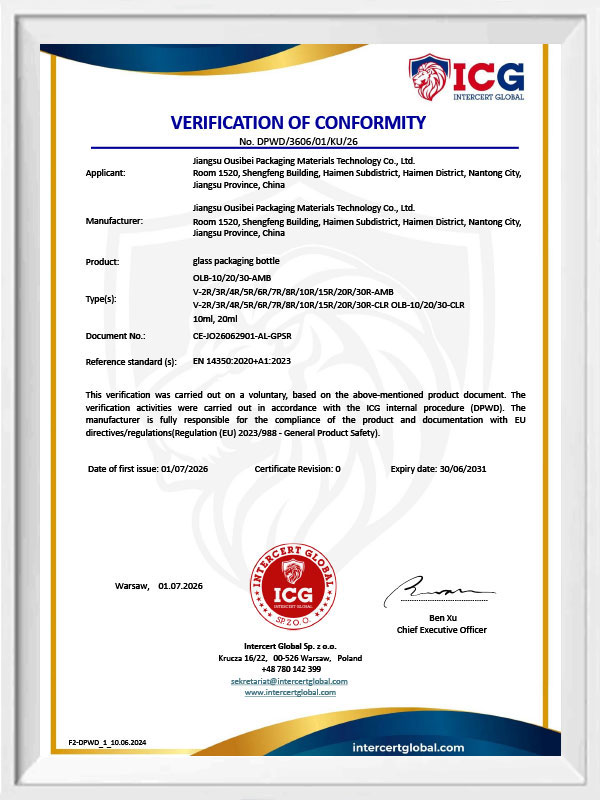
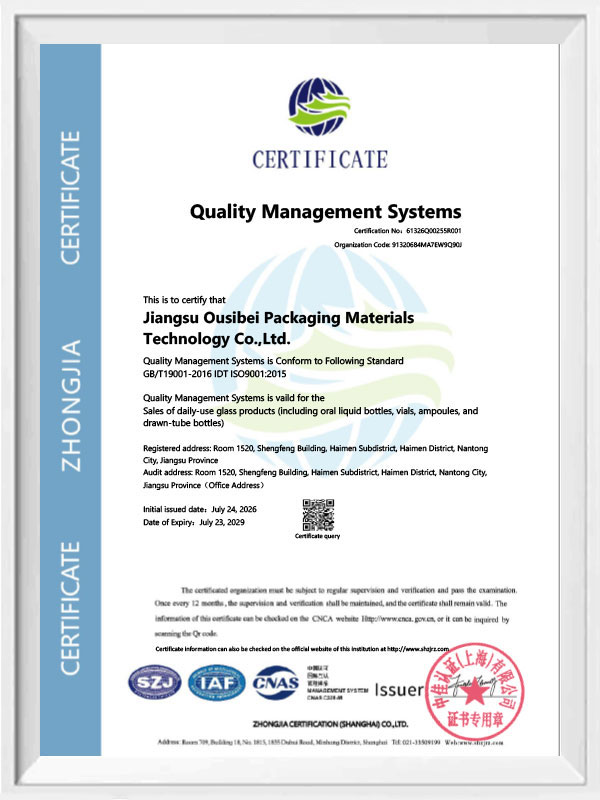
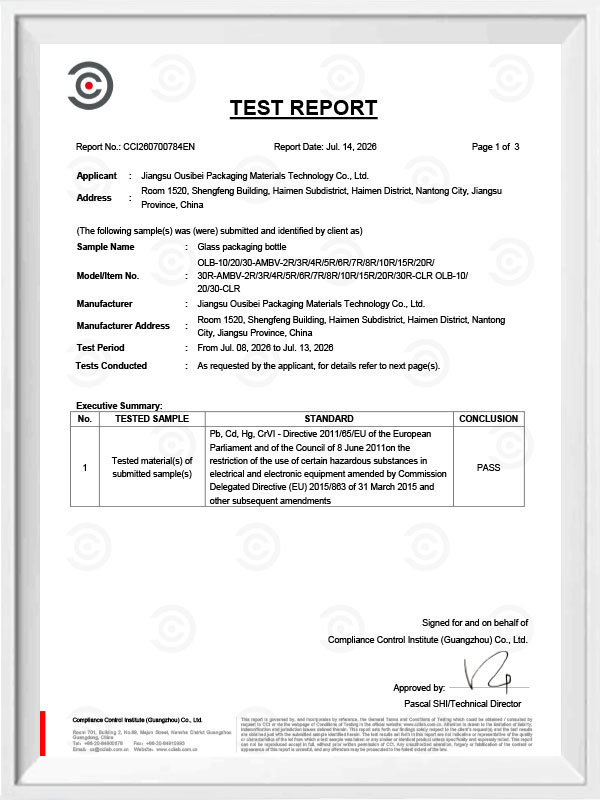
Certificate Of Honor


Industry Knowledge Expansion
Jiangsu Ousibei Packaging Material Technology Co., Ltd. manufactures Mini Glass Spray Bottles for brands and fillers working in skincare, aromatherapy, personal care, disinfection and laboratory sampling. The range covers 2 ml to 15 ml clear and amber soda-lime-silica glass bottles with a precision screw neck, supplied as a complete bottle-and-pump set or as bare glass for customers who already control their own closure supply.
Our work sits at the front of the filling line: we develop the glass structure, control the neck dimensions that determine seal integrity, and match the pump, dip tube and dust cap to the liquid being filled. Because forming, annealing, inspection and packing run inside our own plant, the bottle that leaves the warehouse is the same bottle that was sampled.
Our Position in Small-Capacity Spray Packaging
Ousibei is a glass packaging manufacturer based in Nantong, Jiangsu, focused on the research, development and production of small glass containers. Mini spray bottles are one of eight product families we run alongside Essential oil bottle and Perfume decanting bottles lines, which means the same forming, annealing and inspection discipline applies to a 5 ml mist bottle as to a pharmaceutical vial.
Twenty dual production lines operate in parallel across two workshops. Each line carries a glass tube through forming, bottle production, annealing, inspection, packing and warehousing without intermediate outsourcing, so dimensional consistency is held by one process owner rather than split across suppliers.
The Range We Supply
Two stocked variants cover the majority of mist and spray applications, and both can be developed further through capacity, finish and closure selection.
| Variant | Glass | Capacities | Best-Fit Contents |
|---|---|---|---|
| Clear mini glass spray bottles | Soda-lime-silica, high clarity | 2 / 3 / 5 / 8 / 10 / 12 / 15 ml | Hydrating mists, toners, floral waters, body mists, plant-based cleaners, colourless lab solutions |
| Amber mini glass spray bottles | Light-blocking amber glass | 2 / 3 / 5 / 8 / 10 / 12 / 15 ml | Diluted essential oils, hydrosols, herbal extracts, alcohol sprays, repair serums, light-sensitive reagents |
Both variants share the same threaded neck geometry, so a brand can run a clear SKU and an amber SKU on one filling line with the same pump specification. Where a project needs a different silhouette, we develop the structure rather than forcing the customer into a stock shape.
Where Mini Spray Bottles Fit
- Beauty and skincare: hydrosol sprays, essence mists, toners and plant-extract sprays where the bottle is part of the product presentation.
- Aromatherapy and fragrance: diluted essential oil blends, fragrance mists and car freshener refills, normally in amber to slow oxidation.
- Sanitisation and care: alcohol sprays, antibacterial solutions and portable disinfectant packaging.
- Professional skincare: non-injectable repair sprays and hydrating treatment serums used in clinics and aesthetic care lines.
- Travel and sampling: decant sizes for retail trial, hotel amenity and e-commerce sample kits.
- Laboratory and R&D: temporary storage and dispensing of aqueous samples and standard solutions.
Specifications That Decide Performance
For a small spray bottle, the neck is the critical feature. Wall thickness uniformity and mouth diameter determine whether the pump seats squarely, whether the assembly holds pressure when inverted, and whether the unit leaks in transit. Our forming process uses servo-controlled wall thickness and holds bottle mouth dimensional tolerance to ±0.03 mm, which is the basis for reliable crimp and screw closure compatibility.
Neck and closure Standard threaded neck compatible with plastic fine-mist pumps, aluminium spray heads and external dust caps; one-piece moulded body with uniform wall thickness.
Material behaviour Soda-lime-silica glass is chemically stable against aqueous solutions and gentle botanical extracts, with no impurity leaching in daily chemical packaging use.
Light management Clear glass maximises content visibility; amber glass blocks UV to slow oxidation of photosensitive oils, hydrosols and extracts.
Configuration and Customisation
We build each order around the filling line and the brand surface, not around a fixed catalogue entry. Capacity development runs from 1 ml to 100 ml across our glass packaging programme, and the mini spray family sits at the small end of that span.
- Capacity: 2, 3, 5, 8, 10, 12 and 15 ml as standard, with intermediate volumes developed on request.
- Glass material: soda-lime glass as standard; low, medium and high borosilicate options where thermal or chemical resistance requirements are higher.
- Structure: straight body, thick-wall, special-shaped and screw-neck designs developed from drawings or samples.
- Surface finishing: screen printing, hot stamping, spray coating and frosting for branding and light control.
- Closure matching: pump, dip tube length, spray head and dust cap specified against the liquid viscosity and target dose per actuation.
For customers with an existing approved bottle, we reproduce from drawings or physical samples. For new programmes, we work from the packaging brief, target market and application scenario through material and structure proposal, mould design, sample production and testing, customer confirmation, then mass production.
Production Control and Inspection
Bottle forming is fully automatic with robotic transfer, so the bottle body is not touched by hand during the process. Glass tubes are loaded, oriented and inspected for bends and cracks before entering the forming machine, where multi-station rotary equipment heats the tube in sections at 1200–1450 °C and forms the mouth, body and bottom in one step.
After forming, high-speed vision cameras check bottle height, outer diameter, inner mouth diameter, wall thickness and bottom concavity, and reject out-of-tolerance pieces while logging data for traceability. Bottles then pass through a continuous mesh-belt annealing furnace with segmented temperature control, held at 580–620 °C for 2–3 hours and cooled on a slow gradient to remove internal stress that would otherwise cause cracking during washing or sterilisation.
A final inspection machine screens for 77 defect types including cracks, bubbles, black spots, stones, chipped mouths, uneven bottoms and loose glass particles. Each carton carries a traceability QR code recording the forming machine, batch number and production time, which is the record we return to if a customer raises a deviation.
Filling Line Integration and Handling
Mini spray bottles are usually filled on semi-automatic or automatic monoblock lines with a screw capping station. Because our bottles are one-piece moulded with consistent shape and wall thickness, they index reliably through unscramblers and star wheels without the jamming that comes from oval or variable-height glass.
- Confirm the capping torque and whether the pump is crimped, screwed or press-fitted before we finalise the neck drawing.
- Clean and dry bottles before filling; residual moisture affects both pump action and content stability.
- Select amber glass for contents prone to oxidation or light sensitivity, and clear glass where content visibility drives the purchase decision.
- Avoid prolonged storage at high temperature, and keep adequate cushioning in the outer carton to prevent impact breakage.
Information We Use to Configure Your Solution
A workable proposal needs the working point, not just a capacity. The table below shows what we ask for and how each answer changes the configuration.
| Project input | What it determines |
|---|---|
| Fill volume and headspace | Nominal capacity, bottle height and body diameter |
| Liquid type, viscosity and pH | Glass material grade, pump type and dip tube bore |
| Light sensitivity of the formula | Clear or amber glass, or coated clear glass |
| Target dose per actuation | Pump output, spray pattern and dip tube length |
| Filling line and capping method | Neck thread, mouth tolerance and bottle dimensional envelope |
| Branding and finish | Printing, hot stamping, frosting or spray coating artwork |
| Order quantity and delivery pattern | Stock allocation, tooling route and packing format |
| Packing and documentation needs | Bare bottle cartons, palletising and traceability records |
Send drawings, samples or a filled reference bottle and we can move directly to a structure and material proposal. Standard products carry a lower MOQ for trial orders; customised structures are evaluated against bottle geometry, mould complexity and material requirements.
Packing, Documentation and Support
Qualified bottles are arranged by vacuum suction robotic arms and conveyed to the automatic carton packaging machine, which counts, boxes, seals, labels and palletises. Bare-bottle finished cartons are the standard export format for customers who fill in-house, and each carton is traceable to its forming machine and batch.
Our technical R&D, production management and quality control team handles glass forming process development, structural design and product consistency control. Sampling is fast, customisation is flexible, and mass production runs on the same lines that produced the approved sample. Where a project needs a different container format, our wider glass range covers Tubular vial and Oral liquid bottle families for pharmaceutical and nutraceutical filling.
Frequently Asked Questions
Which capacities do you produce in mini glass spray bottles?
Our standard mini spray range covers 2, 3, 5, 8, 10, 12 and 15 ml in both clear and amber glass. Intermediate volumes can be developed, and our wider glass packaging programme supports capacity development from 1 ml to 100 ml.
Should I choose clear or amber glass?
Amber glass blocks UV and slows oxidation, so it suits essential oil blends, hydrosols, herbal extracts and other photosensitive formulas. Clear glass gives full content visibility and suits toners, floral waters, body mists, cleaners and colourless laboratory solutions. Both share the same neck geometry, so the two can run on one filling line.
Are the bottles supplied with pumps and caps?
Yes. We supply complete bottle-and-pump sets with fine-mist plastic pumps, aluminium spray heads and dust caps, and we match the pump output, spray pattern and dip tube length to your liquid and target dose. Bare glass is also available for customers who already control their closure supply.
How do you control neck dimensions and seal quality?
Bottle mouths are formed on servo-controlled multi-station rotary machines with dimensional tolerance held to ±0.03 mm. High-speed vision inspection checks inner mouth diameter, outer diameter, height and wall thickness after forming, and a final inspection machine screens 77 defect types before packing.
Can you print or frost our brand on the bottle?
We offer screen printing, hot stamping, spray coating and frosting. Artwork is applied to the agreed bottle structure after sampling confirmation, and finishes can be combined with either clear or amber glass depending on the light-blocking and visual result you need.
What do you need to quote a custom mini spray bottle?
Fill volume, liquid type and viscosity, light sensitivity, target dose per actuation, filling and capping method, branding requirements, order quantity and packing format. Drawings, samples or a filled reference bottle let us move straight to a material and structure proposal.
Quick Links
Product
Contact Information
- Add: Suite 1520, Sucheng Building, 233 Ruijiang Road, Haimen District, Nantong City, Jiangsu Province, China
- Tel: +86-18795716669
-
Email:
manager@ausbaypkg.com sales@ausbaypkg.com export@ausbaypkg.com
Contact Us
Copyright by Jiangsu Ousibei Packaging Material Technology Co., Ltd. Rights
Reserved.
 Custom Little Glass Spray Bottles Suppliers
